

Narwhal
The narwhal is one of the world's most recognizable whales and one of the most fascinating representatives of Arctic fauna. The main reason for this is the male's tusk, a spiral-shaped canine tooth from the upper jaw that grows for a lifetime and can be up to 3 m (9 ft 10 in) long. Females usually develop normal canines. In rare cases, animals of both sexes may have two tusks. Without the tusk, males can reach a length of 5.5 m (18 ft).
One of the deepest diving whales
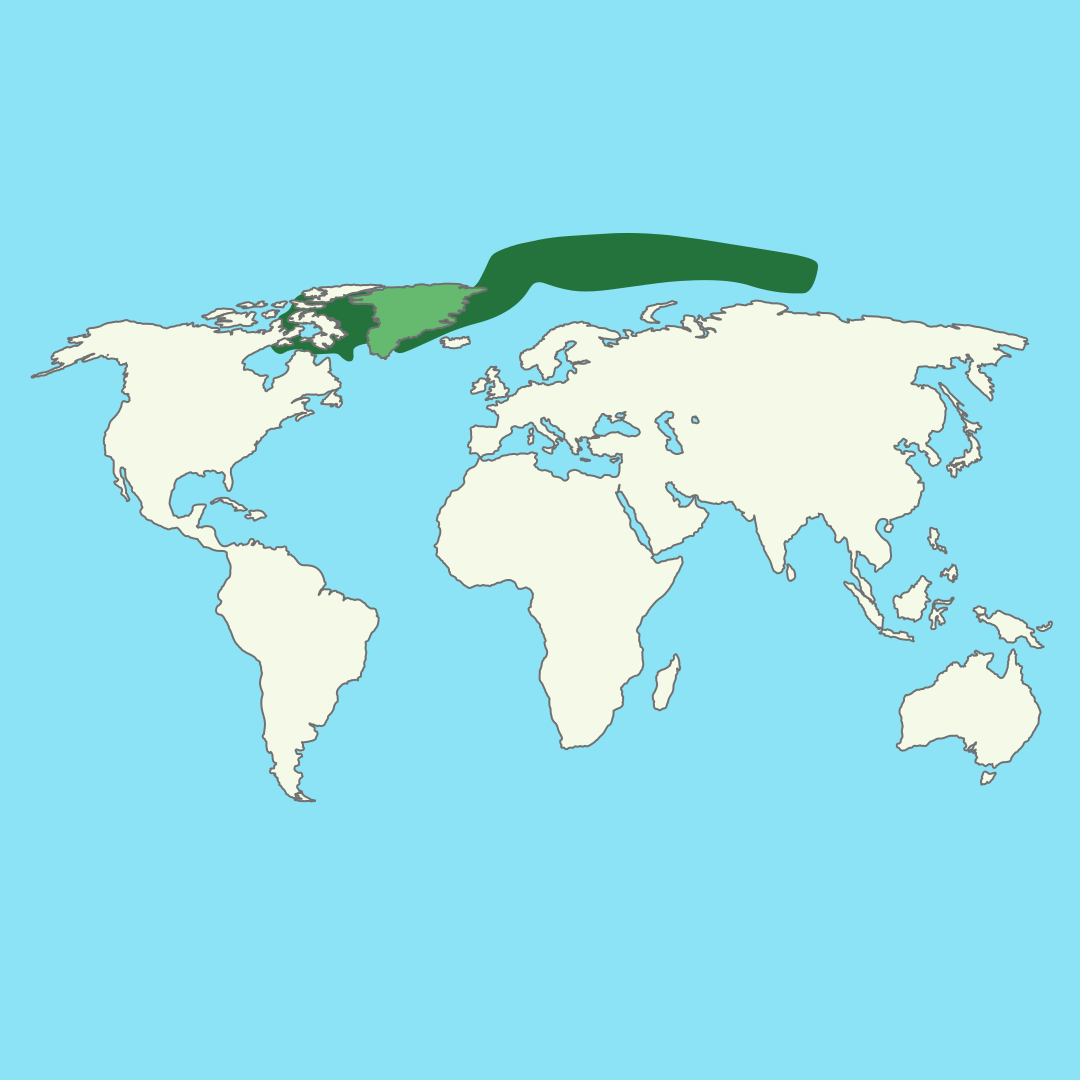
The narwhal's dives to depths of up to 2,370 m (7,780 ft) are among the deepest of all whales. Its range is in the Arctic Ocean, mainly in the Canadian Arctic island world, around Greenland and along the coasts of Siberia.
Legend of the unicorn
From the Middle Ages, the narwhal gave rise to the belief in the famous mythical unicorn. The tusk was thought to be the horn of a unicorn. While its actual origin remained unknown until the 17th century, it was said to have magical powers and was used as a remedy against the plague, as a Christian relic and as a symbol of secular power. Eventually, its value rose to twenty times its weight in gold.
Names
The scientific name of the narwhal, Monodon monoceros, comes from Ancient Greek and means “single-tooth single-horn”. The English name, on the other hand, is of Old Norse origin. It roughly means “corpse whale” and probably refers to the pale color of its skin and its typical way of floating motionless on the water surface.
Facts
- Binominal name: Monodon monoceros
- Other names: Unicorn of the sea
- First described: 1758 (Carl Linnaeus)
- Distribution: Canadian Arctic island world, around Greenland and along the coasts of Siberia


Narwhal souvenir note
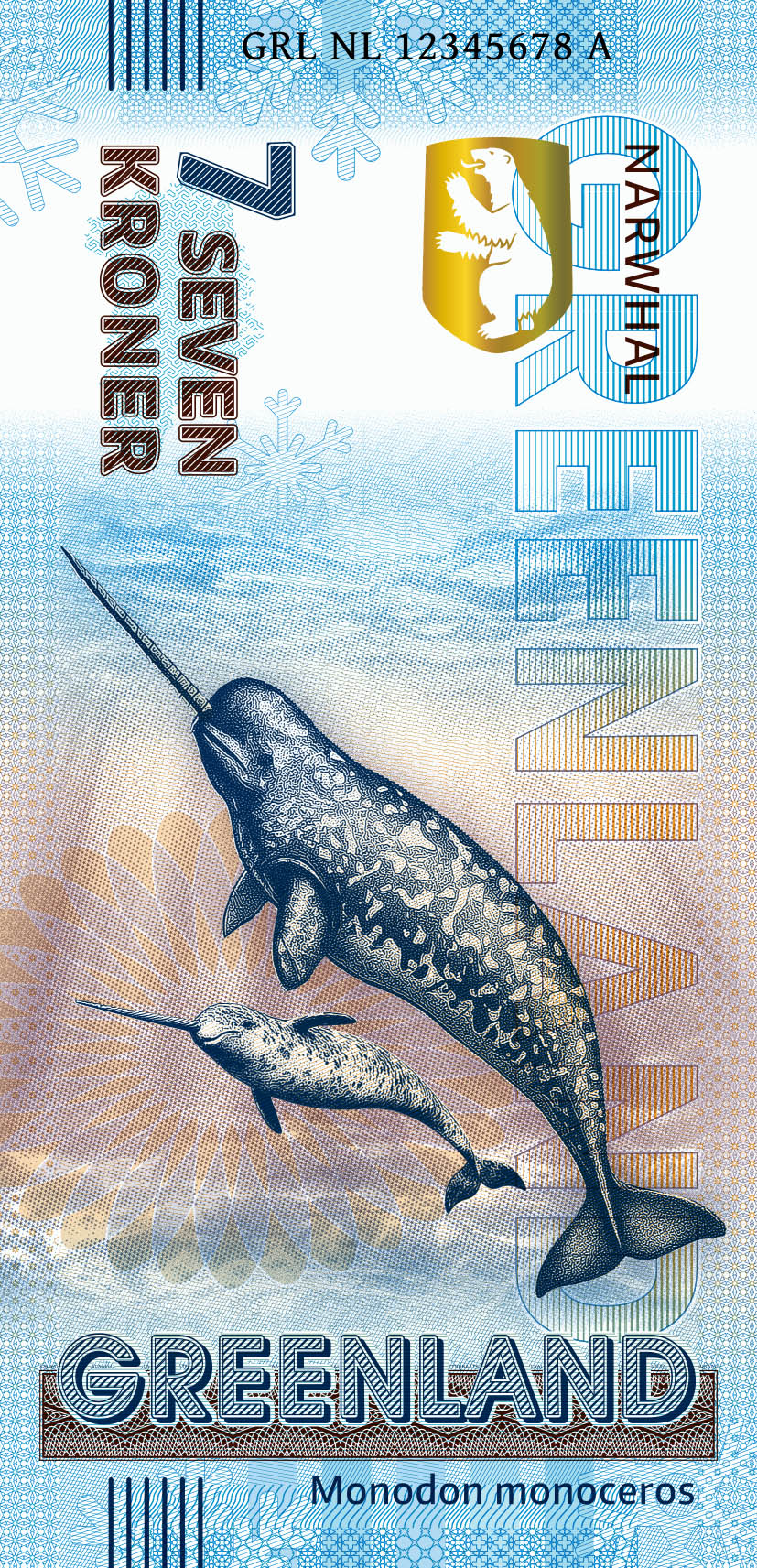
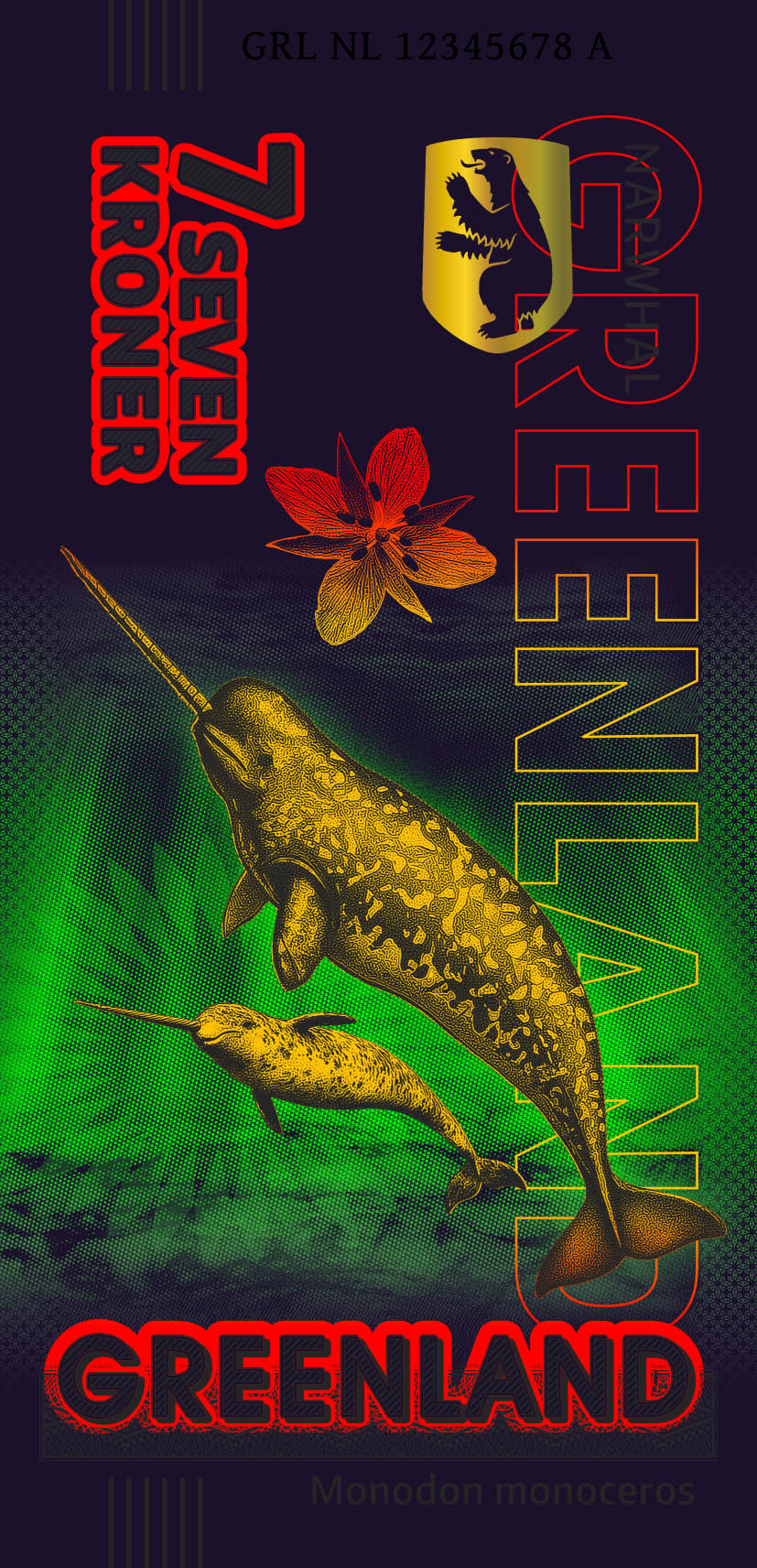
This souvenir note from the Greenland Series is dedicated to the narwhal. Printed on genuine security paper, it features the coat of arms of Greenland as a gold foil patch, motifs in UV color and haptic elements. While the vertically designed obverse depicts a two narwhals, the reverse shows the tail fin of a whale, a coastal glacier and the Kingittorsuaq Runestone, which was discovered in 1824 by a hunter in north-west Greenland and is now in the Danish National Museum. The runes on it are of Norse origin and date from between 1135 and 1330. The Greenland Series which comprises a total of eight souvenir notes, is also available in a booklet with lots of information and pictures.
Obverse: Two narwhals, coat of arms of Greenland, map of Greenland
Reverse: Tail fin of a whale, coastal glacier, Kingittorsuaq Runestone, Inuit art
| Dimensions: 145 x 70 mm (5.71 x 2.76 in) Material: Paper |


