

Greenland muskox
Name and appearance
The Inuit call the muskox “umimmaq” (in English: animal with fur like a beard), which describes its appearance quite well. The English name, on the other hand, is misleading in two ways. Unlike the musk deer, the muskox does not have a musk gland, and thus has not served humans as a source of the coveted scent. However, the urine of male muskoxen during the mating season gives off a similar odor. Furthermore, they are not actually oxen, but caprines like sheeps and goats, albeit very large ones. Bulls can reach a shoulder height of 1.50 m (4 ft 11 in). Both males and females have strikingly curved horns.
Distribution range
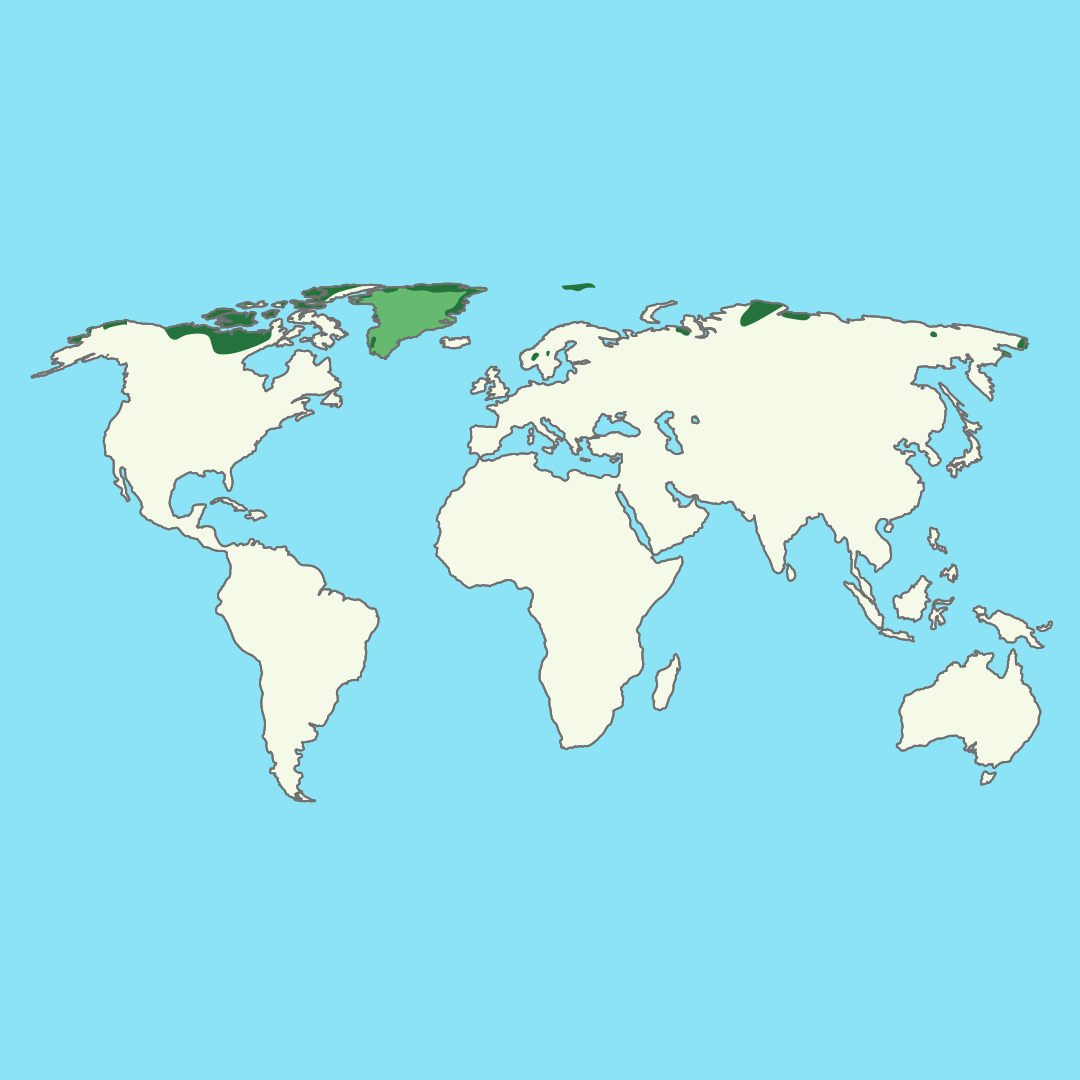
After the last specimens in Siberia died out in the 5th century BC, the habitat was limited to the tundra of North America. At the beginning of the 20th century, the population in Alaska also disappeared, mainly due to hunting. However, the reintroduction of animals from Greenland in the 1930s was successful. It was also possible to reintroduce herds in Norway, Sweden and Siberia. There are two subspecies. The muskoxen from Greenland (Ovibos moschatus wardi) can be distinguished from the population in Canada (Ovibos moschatus moschatus) by a white spot on their forehead.
Coat
As protection against the cold, muskoxen have a thick coat made up of several types of hair. The longest hairs reach almost to the ground and give the animal its distinctive appearance. The undercoat is comparable to that of cashmere goats and is therefore of high quality.
Facts
- Binominal name: Ovibos moschatus wardi
- Other names: White-faced muskox, umimmaq (Inuktitut for “animal with fur like a beard”)
- First described: 1900 (Richard Lydekker)
- Distribution: Coastal areas of northern and southwestern Greenland (introduced to Alaska, Norway, Sweden and Siberia)


Muskox souvenir note
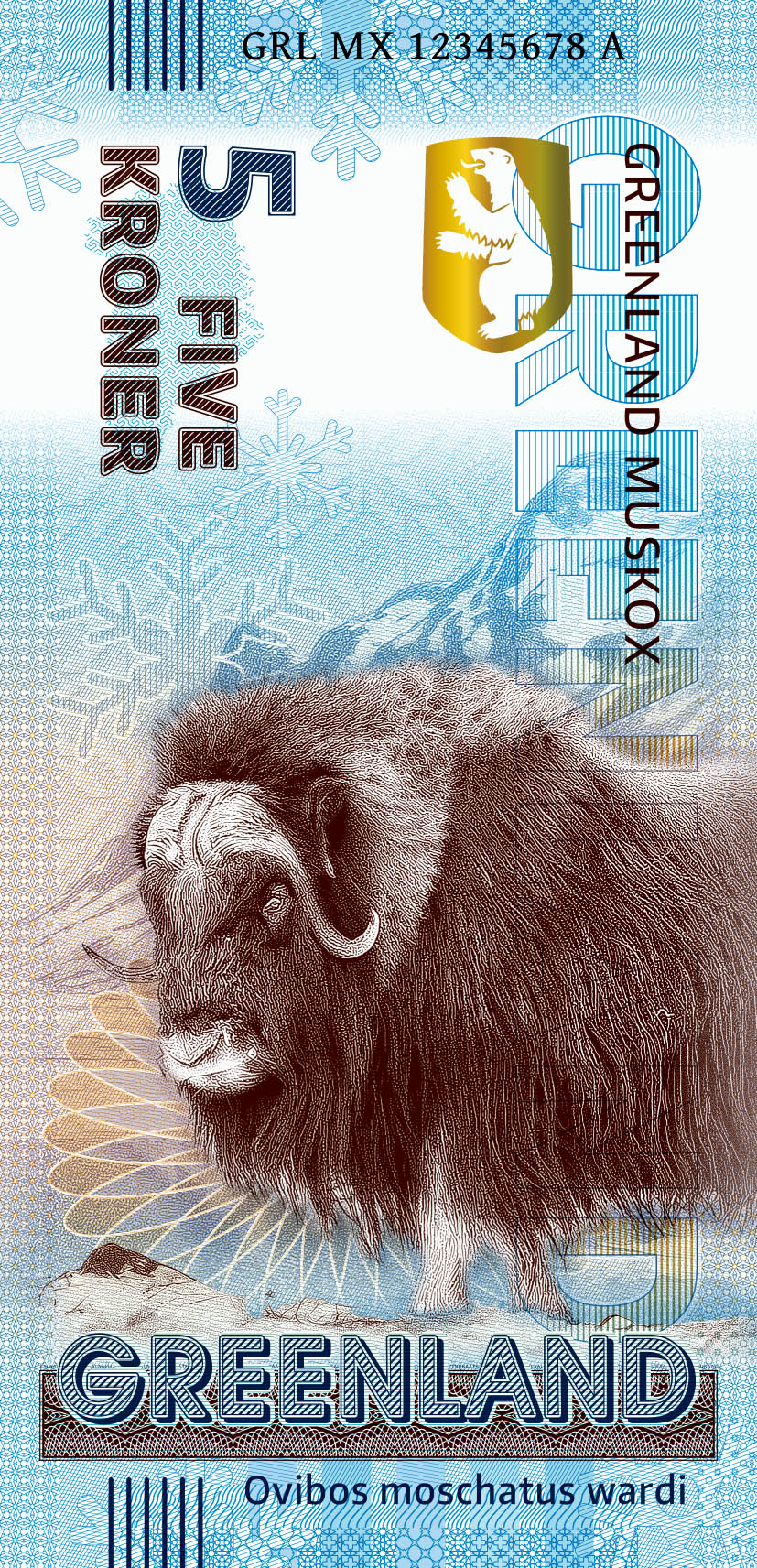
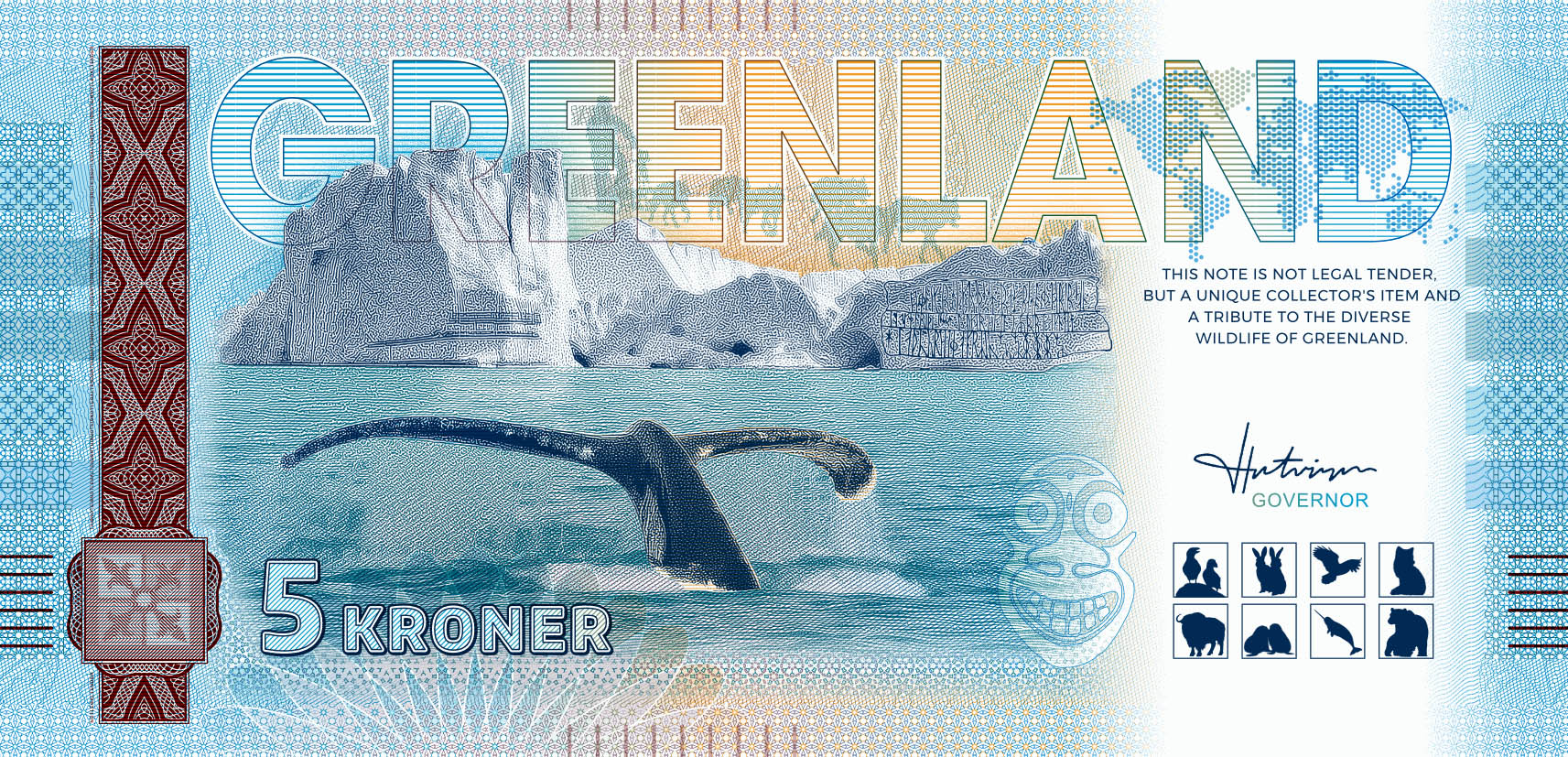
This souvenir note from the Greenland Series is dedicated to the muskox. Printed on genuine security paper, it features the coat of arms of Greenland as a gold foil patch, motifs in UV color and haptic elements. While the vertically designed obverse depicts a muskox, the reverse shows the tail fin of a whale, a coastal glacier and the Kingittorsuaq Runestone, which was discovered in 1824 by a hunter in north-west Greenland and is now in the Danish National Museum. The runes on it are of Norse origin and date from between 1135 and 1330. The Greenland Series which comprises a total of eight souvenir notes, is also available in a booklet with lots of information and pictures.
Obverse: Greenland muskox, coat of arms of Greenland, map of Greenland
Reverse: Tail fin of a whale, coastal glacier, Kingittorsuaq Runestone, Inuit art
| Dimensions: 145 x 70 mm (5.71 x 2.76 in) Material: Paper |


