

Sally Lightfoot crab
Fascinating locomotion
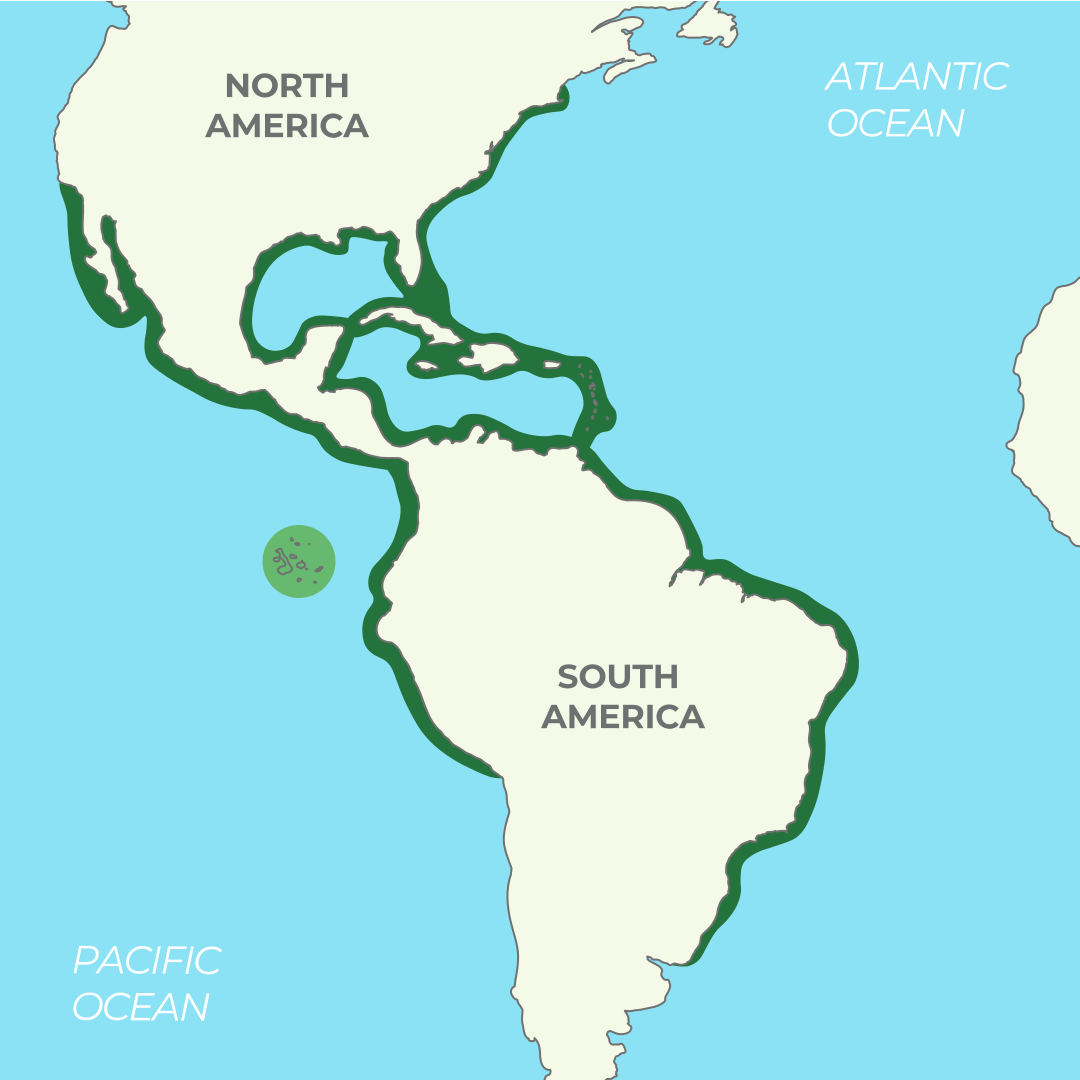
The red rock crab is known for its speed and ability to jump, and is therefore also known as the "Sally Lightfoot crab". Unlike most other crustaceans, it can easily move in all four directions. The crab is one of the most striking animals of the Galápagos Islands. However, it is widespread along the Pacific coast of Latin America from Mexico to Peru, and partly also in the Atlantic Ocean. While juveniles have black or dark brown carapaces and are very well camouflaged on the volcanic rock of the islands, the color spectrum of adult animals includes much lighter shades, from red and pink to yellow.
Symbiosis on the Galápagos Islands
The Sally Lightfoot crab was also among the species collected by Charles Darwin. On the Galápagos Islands, it lives in symbiosis with the marine iguana, which it frees from parasites and ticks. The Sally Lightfoot crab is inedible for humans, but is used as bait for fishing.
FACTS
- Binominal name: Grapsus grapsus
- Other names: Red rock crab, Zayapa (local name)
- Distribution: Pacific coast of Central and South America from Mexico to Peru, Atlantic coast of South America
- First described: 1758 (Carl Linnaeus)



Sally Lightfoot crab Folding Card
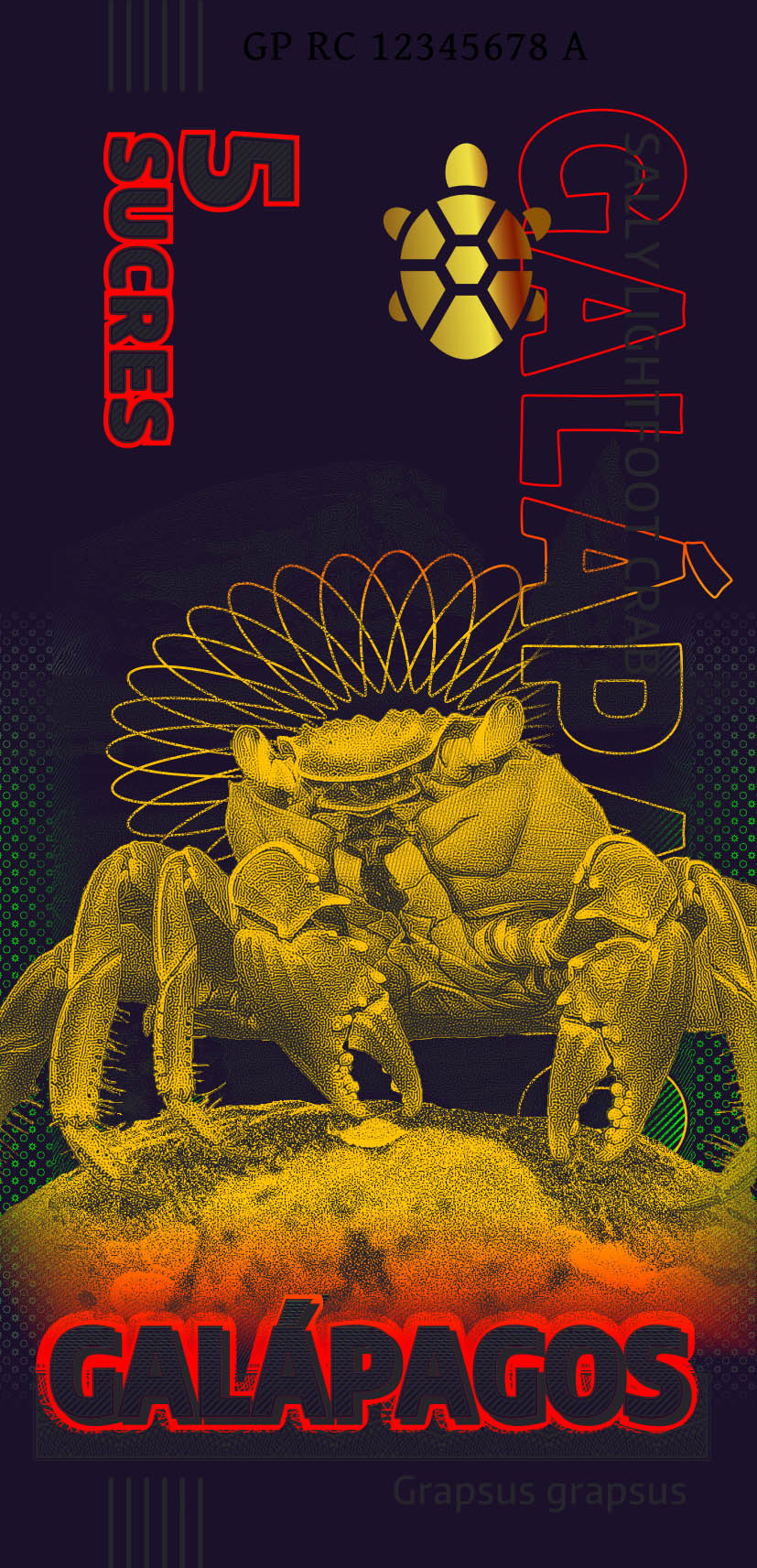
This souvenir note from the Galápagos Series is dedicated to the Sally Lightfoot crab. Printed on genuine security paper, it features a Galápagos tortoise as a gold foil patch, motifs in UV color and haptic elements. While the vertically designed obverse depicts a crab and the Pinnacle Rock on Bartolomé Island in the background, the reverse shows a portrait of Charles Darwin and Darwin's Arch before its collapse in 2021. Under UV light, the current appearance of the rock formation is visible. The Galápagos Series, which comprises a total of eight souvenir notes, is also available in a booklet with lots of information and pictures.
Obverse: Sally Lightfoot crab, Pinnacle Rock on Bartolomé Island, stylized Galápagos tortoise, map of the Galápagos Islands
Reverse: Darwin's Arch rock formation southeast of Darwin Island, portrait of Charles Darwin (1809-1882)
| Dimensions: 145 x 70 mm (5.71 x 2.76 in) Material: Paper |


