
New Jersey
With an area of 8,722.58 square miles (22,591.38 km²) and about 9.3 million inhabitants, New Jersey is the most densely populated U.S. state. It is located in the Mid-Atlantic region in the Northeastern United States. Despite the high density of development, nearly half of New Jersey is still covered by forest. The Pinelands National Reserve in the south was established in 1978 as one of the first national reserves.
The Lenape were the predominant indigenous tribe in New Jersey. In 1609, English navigator Henry Hudson was commissioned by the Dutch East India Company to explore the Hudson River, which was named in his honor. After the Dutch and Swedes had founded their first colonies, the English took control of the area in 1664 and created the Province of New Jersey. It was named after the largest of the Channel Islands. During the American Revolutionary War, a number of major battles were fought in New Jersey. To commemorate the victory of the Continental Army at the Battle of Trenton on 26th December 1776, a 150 feet (46 m) tall column topped by a statue of George Washington was erected in Trenton in 1893.
In 1787, New Jersey became the third state to be admitted to the Union, and in 1789 it was the first state to ratify the United States Bill of Rights. New Jersey played a major role in the Industrial Revolution and is home to many important companies. Thomas Edison built the world’s first electric lighting system with overhead wires in the town of Roselle in 1883. As a center of biopharmaceuticals, the state is also called the "Medicine Chest of the World". The state motto is "Liberty and Prosperity."
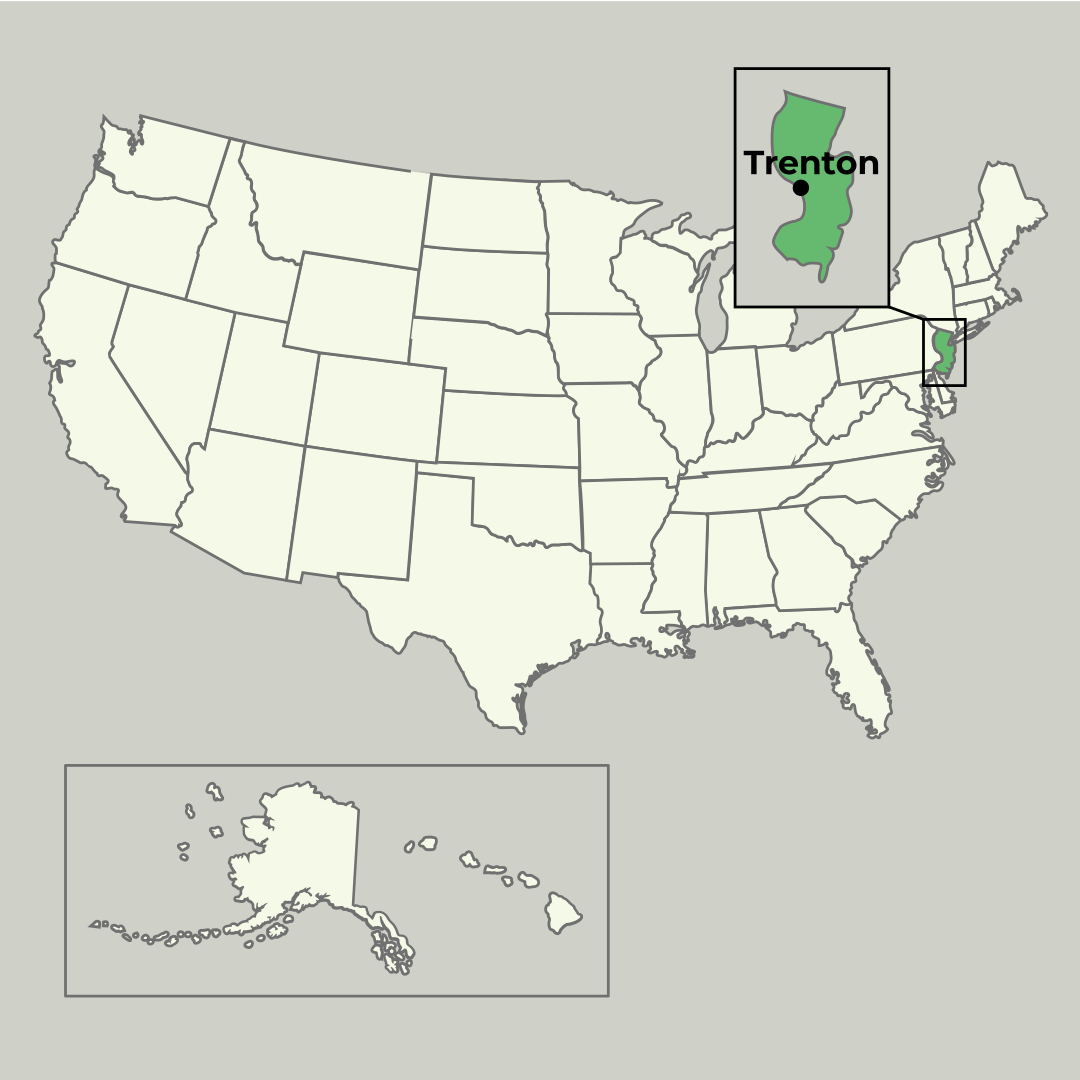
Facts
- Capital city: Trenton
- Largest city: Newark
- Area: 8,722 square miles (22,591 km²)
- Population: 9.3 million
- Date of statehood: 18th December 1787
- Rank of the admission: 3rd


New Jersey Folding Card
Through achievements such as the development of the theory of relativity or the Nobel Prize-winning discovery of the photoelectric effect, Albert Einstein became one of the most important physicists of all time. A German-born Jew, he emigrated to the United States in 1933, worked at the Institute for Advanced Study in Princeton, New Jersey, and became a U.S. citizen in 1940. This note of the 50 U.S. States Program depicts a portrait of Einstein, some of his calculations including a grid representing the curvature of space-time, the Newark skyline, the state motto "Liberty and Prosperity," and the year of admission to the Union.
100 Souvenir Dollars
Obverse: Albert Einstein (1879–1955), theoretical physicist, curve graph and mathematical calculations, skyline of Newark
Reverse: United States Capitol in Washington, D.C., seals of the commemorative series
| Dimensions: 7.07 x 3.00 inches (179.50 x 76.20 mm) Material: Paper |