
Hawaii
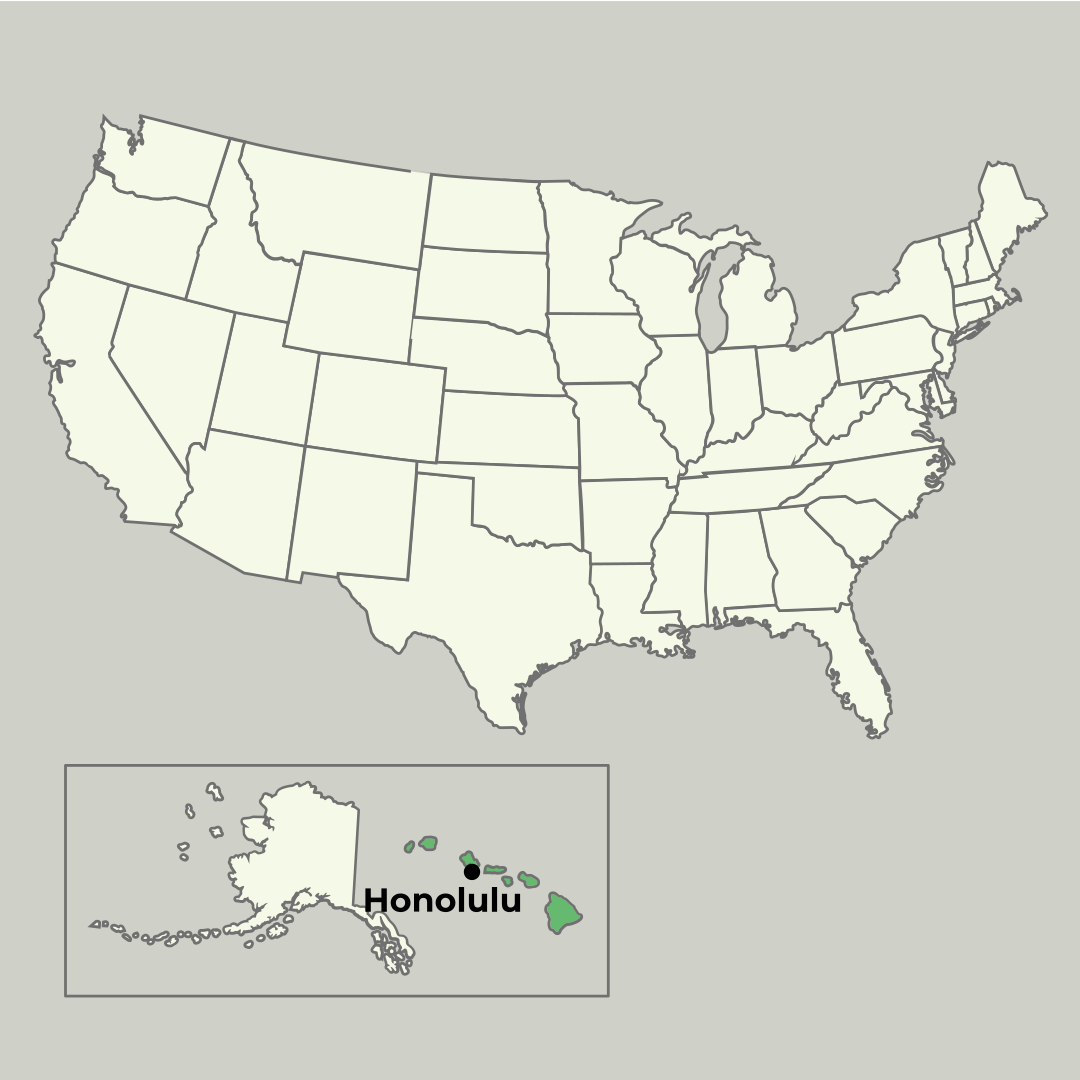
Hawaii is the only U.S. island state and the only U.S. state outside North America. The archipelago is located about 2,000 miles (3,200 km) from the U.S. mainland and belongs to the Polynesian part of the Pacific Ocean. It comprises eight main islands and 129 smaller ones. The capital Honolulu is situated on the island of O’ahu. Native Hawaiians settled on the islands around a thousand years ago. In 1778, the explorer James Cook was the first European to reach the archipelago. As a testimony to the close ties with the British, the state flag of Hawaii features the Union Jack. It is the only flag of a U.S. state with a foreign national symbol. Since becoming a U.S. territory in 1900, Hawaii has been of great strategic importance, with Pearl Harbor being the largest naval base in the world. In 1959, Hawaii was admitted to the Union as the 50th and most recent state.
The indigenous culture of Hawaii shares many costums with other Polynasian nations, but also has some unique traditions. It includes a complex mythology and festivals with spectacular fire performances, distinctive food and the world-famous hula dance. The state motto is the Hawaiian phrase "Ua Mau ke Ea o ka ʻĀina i ka Pono" (The life of the land is perpetuated in righteousness).
Due to its stunning nature and tropical climate, Hawaii is one of the most popular travel destinations in the world. Scientists are also attracted by the active volcanoes, which are constantly creating new land through lava flows. Mauna Kea is considered the highest mountain in the world, measured from the underwater base to the peak, with a height of 33,481 feet (10,205 m).
Facts
- Capital and largest city: Honolulu
- Area: 10,931 square miles (28,311 km²)
- Population: 1.4 million
- Date of statehood: 21st August 1959
- Rank of the admission: 50th


Hawaii Folding Card
In 1810, Kamehameha I succeeded for the first time in conquering all the Hawaiian islands and uniting them into one kingdom. While many other Pacific islands were colonized, Hawaii remained independent until the end of the 19th century. To maintain cohesion, Kamehameha unified the legal system and pushed trade with the West. This note of the 50 U.S. States Program depicts a portrait and statue of the king, Waikīkī Beach at the base of Diamond Head volcanic cone in Honolulu, flowers of the Hawaiian hibiscus (state flower), the state motto "Ua Mau ke Ea o ka ʻĀina i ka Pono" (The life of the land is perpetuated in righteousness), and the year of admission to the Union.
100 Souvenir Dollars
Obverse: Kamehameha I (c. 1758–1819), first king of Hawaii, Waikīkī Beach and Diamond Head volcanic cone in Honolulu, Hibiscus flowers, statue of Kamehameha I, Hawaian native patterns
Reverse: United States Capitol in Washington, D.C., seals of the commemorative series
| Dimensions: 7.07 x 3.00 inches (179.50 x 76.20 mm) Material: Paper |